Self-study with AI: the two methods that work and how to force them
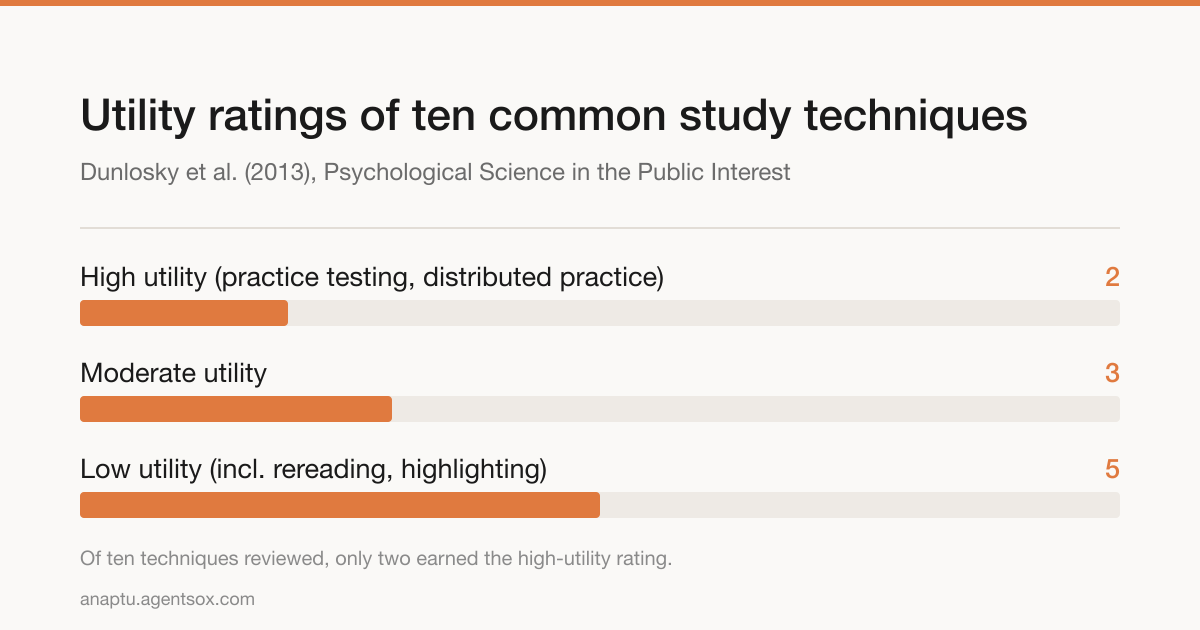
Self-study fails predictably because people default to rereading and highlighting, the two techniques research rates lowest. Only two methods earned a high-utility rating across ages and materials: practice testing and distributed practice. Both are unpleasant to self-administer, which is exactly why the right way to learn with AI is to make it enforce them.
Self-study fails on method long before it fails on discipline. Most people reread, highlight, and watch, and those are precisely the techniques the research rates lowest.
What actually works in self-study
In self-study two methods actually work: retrieval practice and practice distributed over time. In the review of ten common techniques by Dunlosky and colleagues, only two earned a high-utility rating across ages, materials and settings, and those are the two. Rereading and highlighting, the two things most people actually do, landed at the bottom.
The size of the difference is not subtle. In Karpicke and Roediger's 2008 study, people who kept being tested recalled about 80% of the material a week later; people who kept rereading recalled 36% and 33%, and felt more confident doing it.
| Method | Rating in the review | What it really measures |
|---|---|---|
| Practice testing | High | What comes back from memory |
| Distributed practice | High | What survives across weeks |
| Rereading, highlighting | Lowest | How familiar the page feels |
Why almost nobody does what works
The two effective methods share an unpleasant property: they surface failure.
A retrieval attempt that fails feels bad. A spaced schedule keeps returning to material just as it starts slipping, which is exactly when reviewing it feels hardest. Rereading, by contrast, feels smooth and productive while measuring nothing. The methods that work are the ones people quit, and that is a design problem, not a willpower problem.
How to use AI for self-study
Learning with AI properly means using it to force retrieval, not to generate more reading material. That is the practical difference between a tool that produces text and a tool that teaches.
A regular chat tends to hand you more paragraphs, and paragraphs are the resource you already have in surplus. What is missing is an AI tutor that teaches instead of giving answers. It asks you a question at the right interval. It checks your answer. It remembers that you failed this topic last week. When the goal is bigger, a personalized learning plan AI builds the path backward from it, the way a personal AI course does.
How much time each topic needs
An hour a day across five days beats five hours in one day, even when the total time is identical.
The reason is the spacing itself: in Cepeda and colleagues' findings, the optimal gap between sessions depends on how far ahead you need to remember, and the further the horizon, the more the gap should grow. Practical consequence: a plan built from twenty-minute units survives a busy month. A plan that needs long blocks does not.
What a good tool does here
A good tool manages the review calendar for you, and that is the part worth delegating. In Anaptu the schedule is automatic: teaching is interrupted by questions and flashcards at intervals, the system remembers which topics you failed and brings them back, and it records which topics you have proven, instead of leaving it to the feeling of familiarity we have already seen is unreliable. That is what it takes to learn anything with AI rather than just read more about it. The Hebrew edition of this article is at the same address in Hebrew.
Sources
- Dunlosky, J., Rawson, K. A., Marsh, E. J., Nathan, M. J., & Willingham, D. T. (2013). Improving Students' Learning With Effective Learning Techniques. Psychological Science in the Public Interest, 14(1), 4–58.
- Karpicke, J. D., & Roediger, H. L. (2008). The Critical Importance of Retrieval for Learning. Science, 319(5865), 966–968.
- Cepeda, N. J., Vul, E., Rohrer, D., Wixted, J. T., & Pashler, H. (2008). Spacing Effects in Learning: A Temporal Ridgeline of Optimal Retention. Psychological Science, 19(11), 1095–1102.
Questions
- What actually works in self-study?
- Two methods, per the broadest review available: practice testing and distributed practice. Rereading and highlighting, the two things most people actually do, received the lowest utility rating of the ten techniques examined.
- How should I use AI for self-study?
- Use it to force retrieval, not to generate more reading material. A regular chat tends to hand you more paragraphs, which is the resource you already have in surplus. What is missing is something that asks you a question at the right interval, checks the answer, and remembers what you failed last week.
- How much time per day does effective self-study need?
- Less than most people assume, if it is spaced. An hour a day for five days beats five hours in one day even when the total is identical, and a twenty-minute unit survives a busy week where a three-hour block does not.
- Why does rereading feel like it works?
- Because fluency masquerades as knowledge. The material gets easier to read, and the ease feels like understanding. In the Karpicke and Roediger experiment, the rereading group was more confident and remembered less than the retrieval group.
Anaptu turns a one-sentence goal into a structured path, then teaches it and tracks what you have actually mastered. English and Hebrew.
Name your goalKeep reading
Career change with AI: a learning path you can finish
The problem in reskilling is not scarcity of material but excess. How to cut it down to a list you can finish in the time you actually have.
Choosing an AI tutor: five things to check first
Most tools that call themselves an AI teacher are answer engines with a nice interface. Five short tests that separate the two.
How to remember what you learn: spacing, retrieval, and a real schedule
Most of what you learn is gone in a week, and the loss is preventable with two mechanics. What the research says about review timing, and a schedule to copy.