AI tutor for adults: what it teaches that ChatGPT cannot
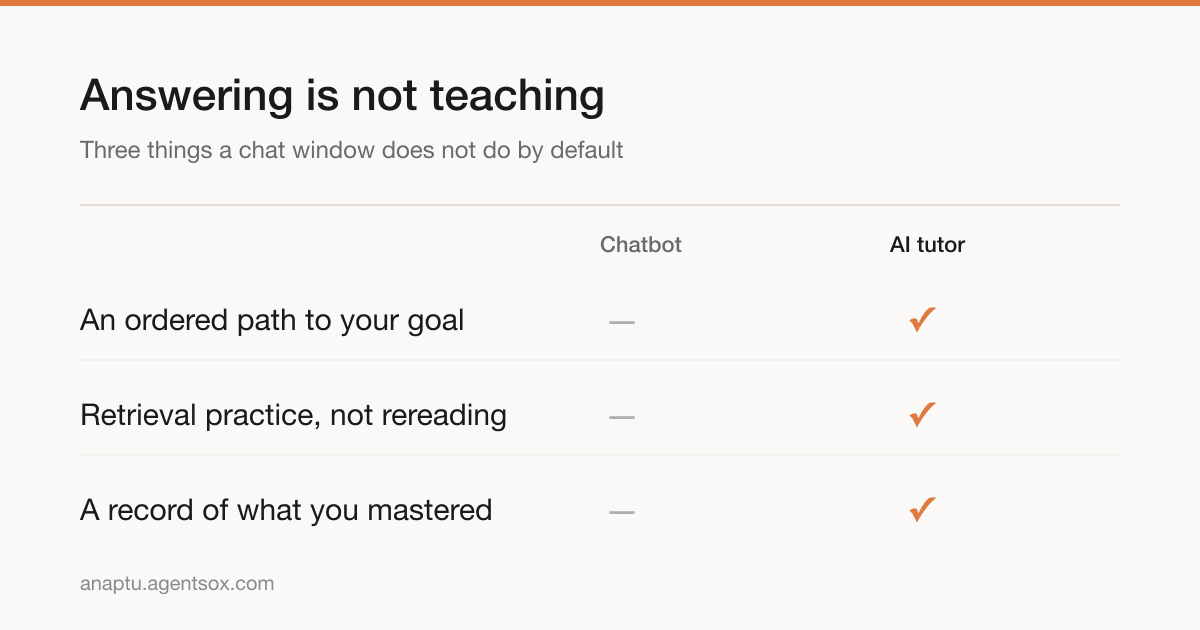
A general chatbot optimises for answering the question you just asked. To learn anything with AI you need three things it does not do: a personalized learning plan AI can order for you, repeated retrieval instead of repeated reading, and a record of what you have actually retained. No prompt makes ChatGPT remember what you failed last week.
Ask a general chatbot to explain TCP congestion control and it will do a good job. Ask it again next week and it will do an equally good job, with no idea that you asked before, no sense of whether you understood it, and no opinion about what you should learn next. That is not a flaw in the model. It is what the tool is for.
Learning a subject is a different problem, and it has three requirements a chat window does not meet by default.
A sequence, decided before you start
The hardest part of self-directed learning is not understanding any individual piece. It is knowing which pieces exist, in what order they make sense, and which ones you can skip for the goal you actually have. Someone learning enough statistics to read a clinical trial needs a different path through the same subject than someone preparing for an exam.
A chatbot cannot help here, because it only sees the question in front of it. You are the one deciding what to ask next, which means you are doing the curriculum design with the least information about the subject of anyone involved.
This is where an AI that builds a curriculum differs from one that answers questions. Anaptu starts by taking a stated outcome and producing an ordered set of topics and subtopics that leads there, which you can edit before any teaching begins.
Retrieval practice, not rereading
The finding that has replicated most often in the learning literature is that trying to recall something retains it far better than reading it again.
In Karpicke and Roediger's 2008 study, students who kept retrieving vocabulary pairs recalled about 80% of them a week later. Students who kept restudying the same pairs but stopped being tested on them recalled 36% and 33%. The authors put it plainly: repeated study after one successful recall produced no measurable learning a week later.
The effect generalises. Dunlosky and colleagues reviewed ten widely used study techniques and rated only two as high utility across ages, materials and settings: practice testing and distributed practice. Rereading and highlighting, the two things most people actually do, both landed in the lowest band.
This is why the teaching here interrupts explanation with quizzes and flashcards on a spaced repetition schedule rather than delivering lessons end to end. The interruption is the mechanism, not a UI decision.
A record of what you have mastered
The third gap is the one people notice last. To know whether you are learning, something has to track which topics you have demonstrated mastery on, and which you have merely read. Your own sense of it is unreliable: in the same 2008 study, students' predictions of their own performance were uncorrelated with how they actually performed.
A chat history is not that record. It is a transcript of what was said, not a model of what you know. Mastery learning needs the second thing.
Where the existing tools sit
Khanmigo and its peers are built around a classroom: a teacher assigns, a dashboard reports, a student follows. That is a real product for a real market, and it assumes someone is supervising. An adult reskilling at 11pm has no teacher to assign anything.
In Hebrew the gap is sharper still. The available tools are strong but each covers one subject, so "I want to learn X" has nowhere to go unless X happens to be maths or exam prep.
What this means in practice
If you have a question, ask a chatbot. It is faster and it is very good.
If you have a goal that will take more than an afternoon, what you need is not a better answering machine. It is a sequence, forced recall, and an honest record of where you are. That is the difference between a tool that answers you and an AI tutor that teaches instead of giving answers.
Sources
- Karpicke, J. D., & Roediger, H. L. (2008). The Critical Importance of Retrieval for Learning. Science, 319(5865), 966–968.
- Dunlosky, J., Rawson, K. A., Marsh, E. J., Nathan, M. J., & Willingham, D. T. (2013). Improving Students' Learning With Effective Learning Techniques. Psychological Science in the Public Interest, 14(1), 4–58.
Questions
- Can I just use ChatGPT instead of an AI tutor?
- You can, and for a single question it is often the faster tool. What it does not do is decide what you should learn next, make you retrieve material instead of rereading it, or track which topics you have mastered. Those three are what turn scattered answers into a subject you know.
- What is the difference between answering and teaching?
- Answering ends when your question is resolved. Teaching sequences material so each piece builds on the last, forces recall at spaced intervals, and checks retention rather than in-the-moment comprehension. Karpicke and Roediger found that repeated study after one successful recall produced no measurable learning a week later, while repeated retrieval did.
- Does rereading my notes work?
- Barely. In the Dunlosky review of ten common study techniques, rereading and highlighting both landed in the lowest utility band, while practice testing and distributed practice were the only two rated high utility. Rereading feels productive because the material gets easier to read, not because you are more likely to recall it.
- Is this useful for reskilling or a career change?
- That is the case it fits best. Self-directed learning toward a specific job outcome is exactly where an ordered path beats a video library, because the sequence can be cut to the goal instead of covering a whole field.
- Does Anaptu support Hebrew?
- Yes, natively, with real RTL layout throughout the interface rather than a translated English shell. You can name a goal in Hebrew and be taught in Hebrew. The Hebrew version of this article is at /he/blog/ai-teacher-hebrew.
Anaptu turns a one-sentence goal into a structured path, then teaches it and tracks what you have actually mastered. English and Hebrew.
Name your goal