How to build a personalized learning plan with AI
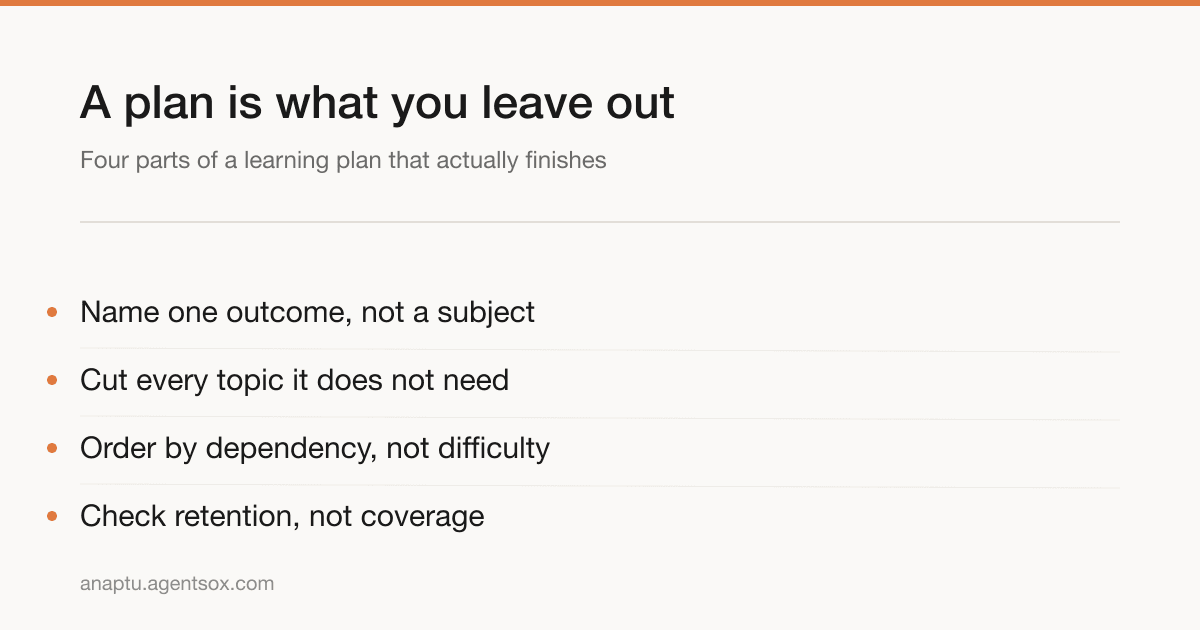
Start from the outcome, not the subject. A personalized learning plan AI can build is only useful if it names one concrete goal, keeps the topics that goal actually depends on, orders them so each unlocks the next, and checks retention rather than coverage. Most plans fail on the second step: they cover a field instead of cutting it.
Most learning plans fail at the same step, and it is not the one people expect. It is not choosing the wrong resources or underestimating the time. It is that the plan covers a field when the learner needed a path to one outcome.
Ask for a plan to "learn statistics" and you get a syllabus: descriptive stats, probability, distributions, inference, regression, ANOVA. Ask for a plan to "read a clinical trial paper and know whether to believe it" and half of that syllabus is noise, one topic that appeared nowhere on it becomes essential, and the whole thing gets three weeks shorter.
What goes into a personalized learning plan
A personalized learning plan needs four things: one named outcome, the topics that outcome depends on, an order in which each unlocks the next, and a retention check. Everything else is decoration.
| Part | The question it answers | Failure mode |
|---|---|---|
| Outcome | What can I do when this is finished? | "Learn X", a subject rather than a capability |
| Scope | Which topics does that actually require? | Covering the field instead of cutting it |
| Order | What has to come first? | Sequencing by difficulty rather than dependency |
| Check | Do I still have it next week? | Measuring coverage instead of retention |
Why start from the outcome and not the subject
Start from the outcome because it is the only thing that tells you what to leave out. A subject has no natural boundary. Every topic connects to another, which is why a syllabus expands until it matches a full university course. An outcome has an edge: "ship a REST API that authenticates users" excludes most of computer science, and the exclusion is the useful part.
This is also the part you should not delegate. You know what you want to be able to do. An AI that builds a curriculum does not, and it will happily produce a competent, thorough, useless plan for the subject if you name a subject.
Should I order topics by difficulty or by dependency
Order by dependency. Difficulty ordering feels natural and produces plans that stall, because the easy topics are often the ones that depend on the hard ones. Order by what each topic unlocks, and difficulty sorts itself out: the hard idea you needed in week one stops being optional and becomes the thing that makes week two make sense.
One exception is worth knowing. Once topics are learnable in any order, mixing them beats finishing one before starting the next. In a randomized trial across 54 seventh-grade classes, students whose practice interleaved different problem types scored 61% versus 38% for students who practiced in blocks, on an unannounced test a month later. Same material, same total practice, different order.
What should the plan leave out
The plan should leave out anything that does not serve the outcome, including the topics that are genuinely interesting. This is the hardest instruction to follow and the one that most changes the result.
A plan is a claim about what you will not study. If it excludes nothing, it has not been built. It has been listed.
How do I know the plan is working
You know the plan is working when you can still do the thing a week later without looking it up. Finishing a topic feels like progress and predicts almost nothing: in Karpicke and Roediger's study, students who kept retrieving material recalled about 80% of it a week later, while students who kept rereading the same material without being tested recalled 36% and 33%. The reading felt productive to both groups.
So the check is simple and slightly uncomfortable. A week after a topic, can you do the thing unaided? If not, the plan does not need more topics. It needs another pass at that one.
Can AI actually build a better plan than I can
For a subject you have not studied, usually yes, for one specific reason. The hard part of planning is knowing which ideas depend on which, and that is exactly the knowledge you do not have before you start. You are being asked to design a route through a city you have never visited.
There is also a long-standing reason to expect personalization to matter. Bloom found that one-to-one tutoring with mastery learning moved the average student two standard deviations, scoring above 98% of the students in the control class. He called the search for a scalable version of that the "2 sigma problem", and it stayed open for forty years because tutors do not scale. Software does.
Keep the judgment about the goal. Delegate the map.
How often should the plan change
Change the plan whenever the outcome changes, and whenever a retention check fails twice. Not otherwise: a plan rewritten every week is a plan you never followed.
Doing this with Anaptu
Anaptu starts here by design. You state an outcome, it produces the ordered topics and subtopics that lead there, and you edit the plan before any teaching begins. Then it teaches against that plan and tracks which topics you have actually retained, which is the check most plans skip.
There is more on why that last part matters in what an AI tutor teaches that ChatGPT cannot, and the rest of these notes are on the blog.
Sources
- Bloom, B. S. (1984). The 2 Sigma Problem: The Search for Methods of Group Instruction as Effective as One-to-One Tutoring. Educational Researcher, 13(6), 4–16.
- Rohrer, D., Dedrick, R. F., Hartwig, M. K., & Cheung, C.-N. (2019). A Randomized Controlled Trial of Interleaved Mathematics Practice. Journal of Educational Psychology.
- Karpicke, J. D., & Roediger, H. L. (2008). The Critical Importance of Retrieval for Learning. Science, 319(5865), 966–968.
Questions
- What goes into a personalized learning plan?
- One named outcome, the topics that outcome depends on, an order in which each topic unlocks the next, and a way to check retention rather than coverage. Anything that does not serve the named outcome is not part of the plan, however interesting it is.
- How long should a learning plan be?
- Short enough that you can see the end of it. A plan you can finish teaches you more than a comprehensive one you abandon in week three, and naming the outcome first is what gives you permission to cut.
- Can AI build a better learning plan than I can?
- For a subject you do not know yet, usually. Sequencing requires knowing which ideas depend on which, and that is precisely the knowledge you lack before you start. You keep the judgment about the goal; the AI supplies the map of the territory.
- How do I know if the plan is working?
- You can still do the thing a week later without looking it up. Coverage is not the measure. Karpicke and Roediger found that repeated study after one successful recall produced no measurable learning a week on, while repeated retrieval did.
Anaptu turns a one-sentence goal into a structured path, then teaches it and tracks what you have actually mastered. English and Hebrew.
Name your goal