Career change with AI: a learning path you can finish

People changing careers do not suffer from a shortage of courses but from a surplus of them, with no way to tell which parts matter. The fix is to start from real job listings instead of a syllabus, translate them into a capability list, delete everything you would learn on the job anyway, and spread what remains across weeks instead of concentrating it into weekends.
Someone deciding to switch careers quickly discovers a surplus, never a shortage. There are endless courses, tracks, and zero-to-hero lists. All of them were built for someone else, though, and there is no way to know in advance which parts are relevant to you.
Then the familiar pattern begins. A first course, and enthusiasm. Week three, and a topic that seems important but disconnected. Then the creeping feeling that none of this moves you toward a job. It usually ends in abandonment, and the shape is why, more than the difficulty. Of ten common study techniques reviewed, the cramming shape most courses assume sits in the lowest utility band. The two that work are exactly the ones a working adult can fit in.
The mistake: starting from a syllabus
A syllabus is the wrong place to start because it was built to cover a field, and you need to be employed in one.
A syllabus is built for completeness. It covers the field because it was designed for a degree or a mass-market course. You do not need to cover a field. You need to be employed in it.
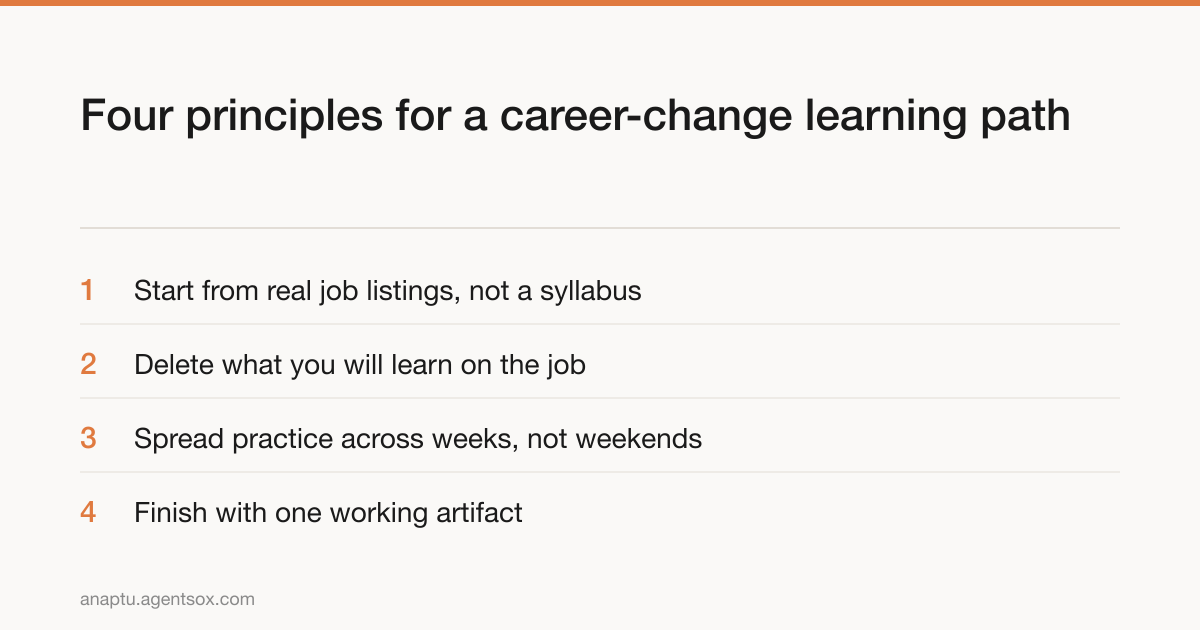
Start somewhere else: open five real job listings for the role you are aiming at. Not articles about the profession, actual listings.
Mark what repeats across all five. That is the core. What appears once is noise, even if it is the most interesting topic on the list. This is the cheapest way to turn what should I learn from an open question into a closed one.
Delete what you will learn on the job
Delete every capability you would pick up in the first two weeks on the job; none of it belongs on the pre-interview path.
Some skills on your list will be learned in the first fortnight at work, in an environment where you would learn them better anyway: internal tools, team processes, specific libraries. They do not belong on the path that comes before the interview.
What must be there is what gets screened: the fundamentals that are hard to learn on the fly, and that someone will probe directly.
The cut feels like giving up and is the opposite. Every topic that stays competes for the same limited time, and a personal AI course you finish teaches more than a comprehensive one abandoned a third of the way in.
Spread, do not cram
Spread the practice: an hour a day across five days beats five hours crammed into one, even when the total is identical.
The natural impulse when studying alongside a job is to concentrate everything into the weekend. That is the worst shape for memory. In the review of ten common study techniques, only two earned a high-utility rating: practice testing and distributed practice, and the synthesis of distributed-practice studies backs the same conclusion across hundreds of comparisons.
| Shape | Survives a busy month? | What research says |
|---|---|---|
| An hour a day, five days | Yes | Distributed practice, high utility |
| Five hours each Saturday | Rarely | Massed practice, the low-utility shape |
There is also a practical consequence for reskilling: a path that requires long blocks simply does not survive a busy work month. A path built from twenty-minute units does.
The gap no course closes
The gap no course closes arrives after a few months: the moment you do not know what you do not know. The list is finished, and it does not feel like readiness.
The work here is testing retrieval rather than learning another topic. Take a real problem, solve it without help, and see where you stop. The point where you stop is your real study list, and it is usually short and surprising.
And for the interview itself: one working artifact you can explain every decision in is worth more than a list of courses. It proves exactly what the employer is trying to verify.
Where AI actually helps
Not with explaining, good explanations were available before. It helps in three places that used to require a person.
Translating job listings into a capability list and a dependency order, the way a personalized learning plan AI does. Testing you on yesterday's material without scheduling anyone. And noticing what you forgot, then timing the return.
In Anaptu that is exactly the flow. You phrase a goal, and getting hired for role X is a legitimate goal. An editable topic path is built from it. Teaching is interrupted by questions and spaced review. The system records which topics you have proven, so am I ready is answered from data rather than feeling. It is what makes it possible to learn anything with AI on a working adult's calendar. The Hebrew edition of this article is at the same address in Hebrew.
Sources
- Dunlosky, J., Rawson, K. A., Marsh, E. J., Nathan, M. J., & Willingham, D. T. (2013). Improving Students' Learning With Effective Learning Techniques. Psychological Science in the Public Interest, 14(1), 4–58.
- Cepeda, N. J., Pashler, H., Vul, E., Wixted, J. T., & Rohrer, D. (2006). Distributed Practice in Verbal Recall Tasks: A Review and Quantitative Synthesis. Psychological Bulletin, 132(3), 354–380.
Questions
- How long does a career change really take?
- It depends far more on the scope of the list you choose than on your learning speed. Most people who stall did not learn slowly; they chose a list built for a degree rather than for a first job. A list cut to what repeats across five real job listings is usually finishable in months of part-time work, not years.
- How do I know what to learn and what to skip?
- Open five real job listings for the role you are aiming at and mark what repeats across all five. What repeats is the core. What appears once is noise, however interesting it is.
- Is an intensive bootcamp schedule better than daily practice?
- A little every day, per the research. Distributed practice is one of only two techniques rated high utility across the literature, and an hour a day for five days beats five hours on one day even at identical total time.
- What should the path end with?
- One working artifact you can explain every decision in. It proves exactly what an employer is trying to verify, and it beats a list of completed courses.
Anaptu turns a one-sentence goal into a structured path, then teaches it and tracks what you have actually mastered. English and Hebrew.
Name your goalKeep reading
Choosing an AI tutor: five things to check first
Most tools that call themselves an AI teacher are answer engines with a nice interface. Five short tests that separate the two.
How to remember what you learn: spacing, retrieval, and a real schedule
Most of what you learn is gone in a week, and the loss is preventable with two mechanics. What the research says about review timing, and a schedule to copy.
Learn from your own material: turn a PDF into a lesson, not a summary
Summarizing a document feels like progress and produces little memory. How to make AI teach you from your material instead of shortening it.