Personal AI course: how to build a course that actually finishes

A good personal course is not a longer course but a shorter one: phrased from one outcome you want to reach, cut down to the topics that outcome actually depends on, ordered so each topic unlocks the next, and measured by what stays in memory rather than what was covered. The reason most online courses get abandoned is that they are built in the opposite direction, from the subject forward.
Online courses fail people for a structural reason, and content quality is rarely it. Some are excellent. They were built for an audience, though. You are not an audience. You have one goal, a particular background, limited time. A course built for everyone has to cover everything anyone might want, so most of it is not relevant to you, and there is no way to know in advance which part.
A personal AI course reverses the direction. Instead of starting from the subject and moving forward, you start from the outcome and build backward, and the difference is measured: people tested on material recalled about 80% of it a week later, versus 36% and 33% for those who reread it. Backward design itself is older than the tools, it is the principle Wiggins and McTighe codified, but until now it required an expert to build the path. That is the part that changed.
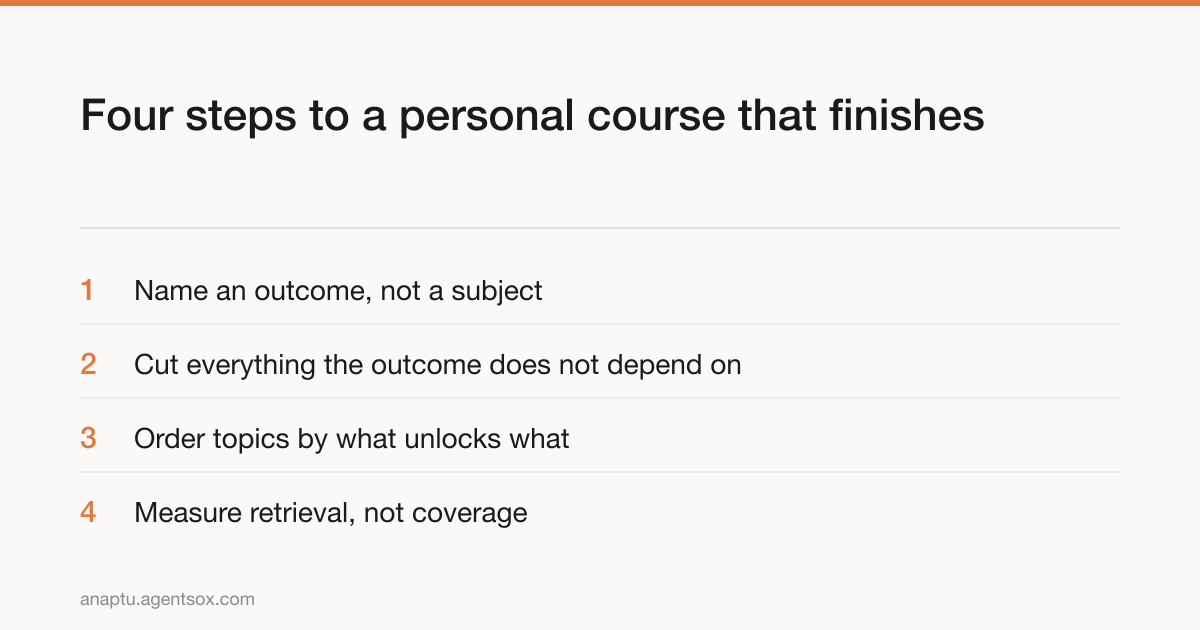
Step 1: phrase an outcome, not a subject
The first step is a phrasing choice. State an outcome, never a subject. The difference between the next two lines shows why:
- Teach me accounting → you get a lecture, starting anywhere.
- I want to read a public company's balance sheet and spot three red flags → you get a path.
The outcome must be something you can tell whether you achieved. Understand statistics is not that. Read the results table of a medical paper and explain what the significance means is.
Step 2: cut
Cutting means deleting every topic your outcome does not directly depend on, however interesting it is.
This is the step people skip, and it is the most important one.
The cut feels like giving something up, and it is the opposite. Every topic that stays on the list competes for the same limited review time, and a course you finish teaches more than a comprehensive one abandoned a third of the way in. If the list does not feel too short, you have not cut enough.
Step 3: order by dependency
Order the topics by what unlocks what, not by the field's academic logic.
Topics are not a list, they are a graph. Some cannot be understood before others. The right order follows dependency rather than academic convention: each topic should be understandable with what you already learned, and should unlock the one after it.
This is also where a personal course beats a YouTube video. A single video explains one idea well. What is missing is the sequence.
Step 4: measure retrieval, not coverage
The last mistake is measuring progress by how many lessons were marked complete. That measures consumption.
The right measure is what comes back from memory without help, days later. The stable finding in learning research is that trying to retrieve material preserves it far better than rereading it. In Karpicke and Roediger's 2008 study, people who kept being tested on word pairs recalled about 80% of them a week later, against 36% and 33% for those who kept reading without being tested. In the same study, participants' predictions of their own performance were uncorrelated with their actual performance: feeling familiar with the material is not a measure.
| How they reviewed | Recalled a week later |
|---|---|
| Kept being tested (retrieval) | about 80% |
| Kept rereading, no testing | 36% and 33% |
The authors put it in one sentence:
Repeated studying after learning had no effect on delayed recall, but repeated testing produced a large positive effect.
And the broader review agrees: of ten common study techniques Dunlosky and colleagues examined, only two received a high-utility rating, practice testing and distributed practice. So a good personal course does not end at the last lesson. It comes back to you.
What to do in practice
In practice there are four moves, made in order. Phrase an outcome. Ask for the topic list before any explanation. Delete half. Ask for a dependency order. Do not start learning before the list looks right to you.
This is what an AI that builds a curriculum does for you. In Anaptu these four steps are the product: you phrase a goal, and an editable path of topics and subtopics is built from it.
Teaching is then interrupted by questions and flashcards on a spaced schedule, and the system records which topics you have proven. The result is an AI tutor that teaches instead of giving answers, built for one goal at a time, which is what lets adults learn anything with AI rather than one packaged subject. The Hebrew edition of this article is at the same address in Hebrew.
Sources
- Karpicke, J. D., & Roediger, H. L. (2008). The Critical Importance of Retrieval for Learning. Science, 319(5865), 966–968.
- Wiggins, G., & McTighe, J. (2005). Understanding by Design. ASCD. The origin of backward design.
- Dunlosky, J., Rawson, K. A., Marsh, E. J., Nathan, M. J., & Willingham, D. T. (2013). Improving Students' Learning With Effective Learning Techniques. Psychological Science in the Public Interest, 14(1), 4–58.
Questions
- What is the difference between a personal course and a regular online course?
- A regular course is built once for a wide audience, so it has to cover everything anyone might want. A personal course is built backward from your goal, so it is allowed to omit. The omission is the feature, not a compromise.
- How do I get an AI to build a course instead of just answering questions?
- Phrase an outcome, not a subject. I want to read a public company's balance sheet and spot red flags produces a path; teach me accounting produces a lecture. Then ask for the list before any explanation, and delete every topic the goal does not depend on.
- How many topics should a personal course have?
- Fewer than feels comfortable. If the topic list does not feel too short, you probably have not cut enough: every topic that stays competes for the same limited review time, and a course that never finishes teaches less than a short one that does.
- How do I know the course is working?
- Check retrieval, not coverage. The right question is what do I remember from last week's topic without looking, not how many lessons did I mark complete. Feeling familiar with the material is not a reliable measure of what will come back when you need it.
Anaptu turns a one-sentence goal into a structured path, then teaches it and tracks what you have actually mastered. English and Hebrew.
Name your goalKeep reading
Career change with AI: a learning path you can finish
The problem in reskilling is not scarcity of material but excess. How to cut it down to a list you can finish in the time you actually have.
Choosing an AI tutor: five things to check first
Most tools that call themselves an AI teacher are answer engines with a nice interface. Five short tests that separate the two.
How to remember what you learn: spacing, retrieval, and a real schedule
Most of what you learn is gone in a week, and the loss is preventable with two mechanics. What the research says about review timing, and a schedule to copy.