How to remember what you learn: spacing, retrieval, and a real schedule

Forgetting is not a personal failing, it is the default behavior of memory, and two mechanics reliably counter it: retrieving material from memory instead of rereading it, and spacing reviews at growing intervals matched to how far ahead you need to remember. Here is the evidence for both, and a concrete schedule to copy.
Forgetting most of what you learned last week is the default, not a defect. Two mechanics reliably beat it. One is retrieval. The other is spacing.
Finding one: retrieve, do not reread
Retrieving material from memory preserves it far better than reading it again, and the gap is large. In Karpicke and Roediger's 2008 study, participants learned word pairs and were split into groups. Those who kept being tested recalled about 80% of the pairs a week later. Those who kept rereading without testing recalled 36% and 33%.
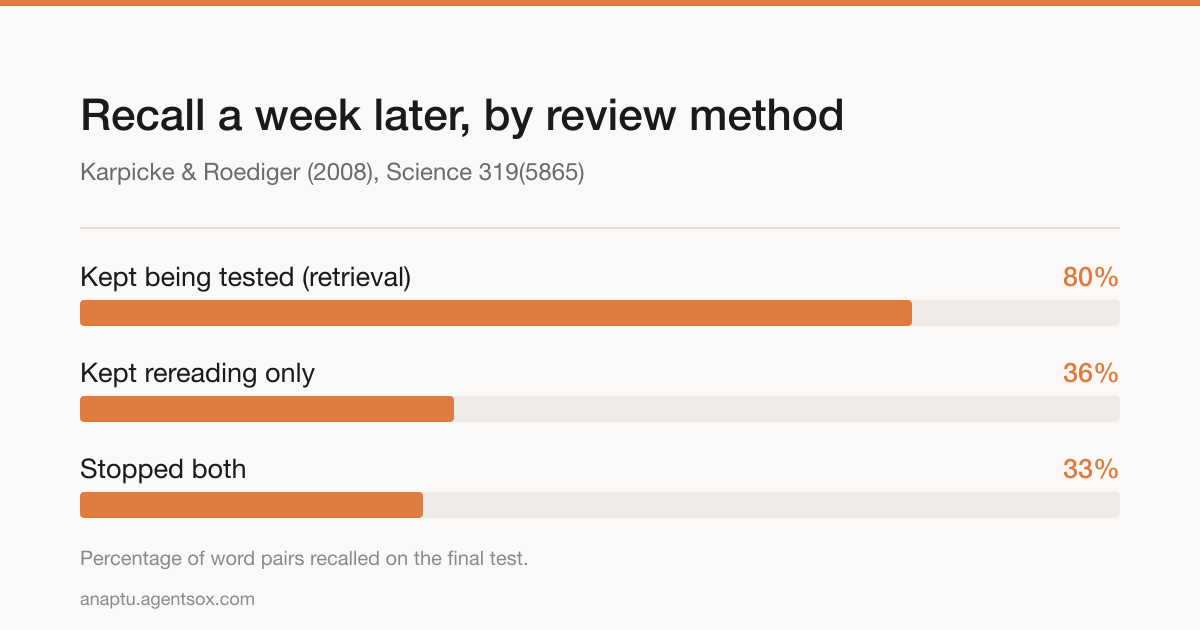
| What they did | Recalled a week later |
|---|---|
| Kept being tested (retrieval) | about 80% |
| Kept rereading, no testing | 36% and 33% |
The authors put it in one sentence:
Repeated studying after learning had no effect on delayed recall, but repeated testing produced a large positive effect.
The troubling detail from the same study: participants' predictions of what they would remember were uncorrelated with their actual performance. Those who reread felt more confident and remembered less. The feeling of mastery is not a measure of mastery, which is why most people keep using the method that does not work. It feels great.
Finding two: the gap depends on the horizon
There is no single right interval between reviews. The right gap depends on how far ahead you need to remember, and that is the practical part most people have never heard.
In Cepeda and colleagues' large analysis, the optimal spacing between sessions grew with the retention horizon: material needed months from now benefits from much wider gaps than material needed next week. Effective review is a schedule that stretches, not a fixed habit.
Why an easy review is wasted
A review that costs nothing strengthens little. An answer that surfaces instantly means the review came too early; the retrieval attempts that take real effort, and occasionally fail, are the ones doing the work. This is also why rereading feels so much better than testing while doing so much less.
What it looks like as a real schedule
After learning a new topic, the pattern to copy is:
- Same day: write from memory what you learned, without looking. Three lines are enough.
- Next day: answer one or two questions on it, again from memory.
- Several days later: one harder retrieval, applied if possible.
- A week or more out: a final check, and if it fails, the topic goes back into rotation.
The intervals widen because the horizon does. If the goal is an exam in two months, the later gaps stretch further still.
What a good tool does here
A good tool runs this calendar for you, and that is the part worth delegating, because a manual review file is exactly what almost nobody keeps past two weeks. When you learn with an AI tutor that teaches instead of giving answers, like Anaptu, the schedule is automatic. Teaching is interrupted by questions and flashcards at intervals. Failed topics come back on their own. Proven mastery is recorded per topic, the way a personal AI course is built to do. That is what lets you learn anything with AI and still have it there a month later. The Hebrew edition of this article is at the same address in Hebrew.
Sources
- Karpicke, J. D., & Roediger, H. L. (2008). The Critical Importance of Retrieval for Learning. Science, 319(5865), 966–968.
- Cepeda, N. J., Vul, E., Rohrer, D., Wixted, J. T., & Pashler, H. (2008). Spacing Effects in Learning: A Temporal Ridgeline of Optimal Retention. Psychological Science, 19(11), 1095–1102.
Questions
- Why do I forget most of what I learn within a week?
- Because a single exposure, however clear, is how memory is designed to behave. Without retrieval attempts and spaced returns, the material decays on schedule. The fix is mechanical, not motivational.
- What is the best interval between reviews?
- There is no single right interval. The optimal gap depends on how far ahead you need to remember: the longer the horizon, the wider the gaps should grow. A useful pattern is same day, next day, several days, then a week or more.
- Is an easy review a good sign?
- Mostly no. If a review costs no effort, it came too early to strengthen much. A retrieval attempt that takes real effort, and sometimes fails, is the one doing the work.
- Can AI manage the review schedule for me?
- Yes, and it is the part most worth delegating, because keeping a manual review calendar is exactly what almost nobody sustains beyond two weeks. A tool can time the questions, check answers, and bring back what you failed.
Anaptu turns a one-sentence goal into a structured path, then teaches it and tracks what you have actually mastered. English and Hebrew.
Name your goalKeep reading
Career change with AI: a learning path you can finish
The problem in reskilling is not scarcity of material but excess. How to cut it down to a list you can finish in the time you actually have.
Choosing an AI tutor: five things to check first
Most tools that call themselves an AI teacher are answer engines with a nice interface. Five short tests that separate the two.
Learn from your own material: turn a PDF into a lesson, not a summary
Summarizing a document feels like progress and produces little memory. How to make AI teach you from your material instead of shortening it.