Choosing an AI tutor: five things to check first

The difference between an AI teacher and a chat is not explanation quality but five things you can check in ten minutes: whether it builds a path before explaining, whether it forces you to retrieve from memory, whether it records what you have internalized, whether it teaches in your language rather than translating, and whether it knows how to say no. A tool that fails three of them is a good answer engine, which is fine, as long as you know what you bought.
Almost every learning tool now calls itself an AI teacher. Most are not. They are good answer engines with a pleasant interface, a legitimate product that solves a different problem.
The difference can be checked in ten minutes, without subscribing for a year. Five tests.
1. Does it build a path before it explains
A teacher builds a path before explaining, so the test is to ask the tool to teach a subject that takes weeks, never a single question.
A chat will start explaining immediately. That is correct behavior for a question and wrong behavior for a goal: it hands you the curriculum planning at exactly the moment you know the least about the subject.
A teacher does the opposite, the way an AI that builds a curriculum must: it asks what you are learning for, and presents a topic list for approval before the first explanation. The clearest sign: you can edit the list, delete from it, reorder it.
2. Does it force you to retrieve from memory
A teacher forces you to retrieve from memory, so the test is whether the tool ever stops explaining to ask you something. One that never does is a tool you consume, not one you learn in.
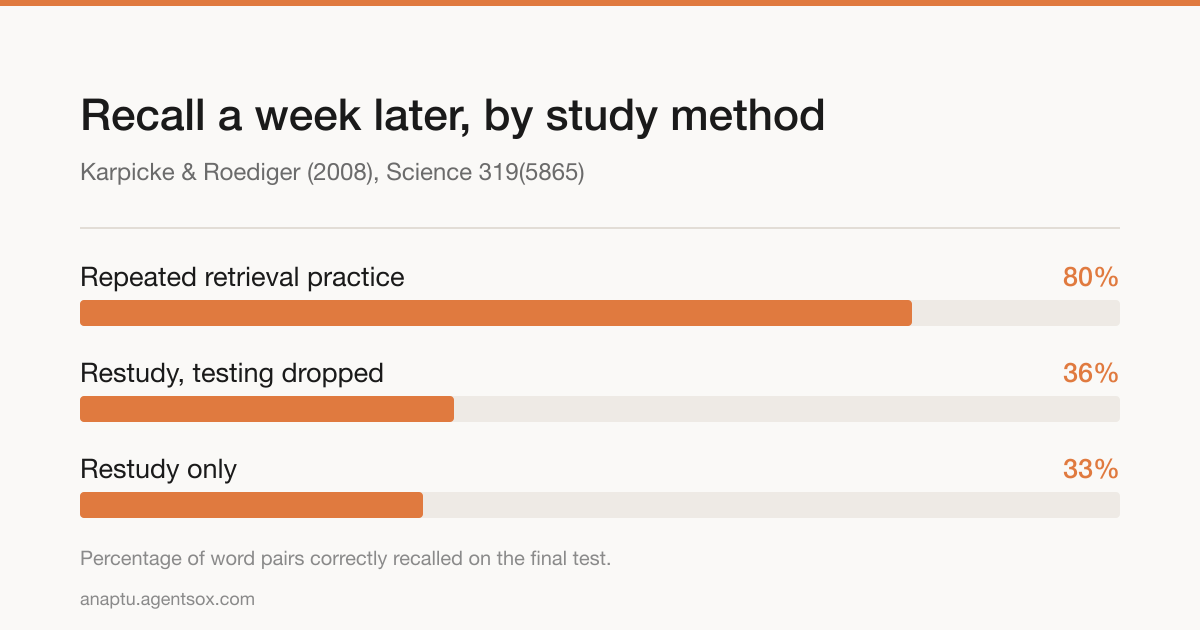
This is the test that is easiest to fake and most important, the line between an AI tutor that teaches instead of giving answers and everything else. A beautiful explanation produces the feeling of understanding; retrieval produces memory.
In the Dunlosky review of ten common study techniques, only two earned a high-utility rating, practice testing and distributed practice. Rereading and highlighting, the two most popular methods, rated lowest.
What to check: does the tool stop and ask you questions, or only keep explaining. Does it return to last week's material without being asked.
3. Does it record what you internalized
A teacher records what you internalized, and a chat cannot: its history is a transcript of what was said, not a model of your knowledge.
The simple question: after two weeks, can the tool say which topics you have proven and which you merely passed through?
This matters more than it seems, because your self-assessment is unreliable. In Karpicke and Roediger's 2008 study, participants' predictions of their future performance were uncorrelated with their actual performance. Those who reread felt more confident and remembered less.
4. Does it teach in your language or translate into it
A teacher teaches in your language; a translator merely renders into it, and translation shows immediately: sentences that run too long, terms that sound like transliterations, and sometimes an interface whose text alignment breaks in right-to-left languages.
What to check: ask a question in your language about a local topic. Does the answer read like someone writing that language, or like a translated English answer. And check the interface itself, buttons, forms, input fields. An interface built for the language's direction from the ground up looks different from one flipped after the fact.
5. Does it know how to say no
A teacher knows how to say no, so the test is to ask it to write your assignment instead of teaching you.
A tool that happily agrees is optimizing the wrong metric: it produces an artifact, not knowledge. A tool that refuses, and instead breaks the assignment down and teaches you to do it yourself, is a tool whose goal is aligned with yours. It sounds like a moral point and is mostly a product test.
The five tests at a glance
At a glance, each of the five tests fits in one line: what you ask, and how a teacher answers differently from a chat.
| Test | What you ask | A chat answers | A teacher answers |
|---|---|---|---|
| Path | Teach me a weeks-long subject | Explains immediately | Topic list for approval |
| Retrieval | Teach me a chapter | More paragraphs | Stops and asks you |
| Record | What have I internalized? | Scroll up | Mastery tracked per topic |
| Language | A local-topic question | Visible translation | Native from the start |
| Saying no | Write my assignment | Writes it happily | Refuses and teaches |
How Anaptu measures against the tests
Anaptu passes the five tests because it was built around them, and in full disclosure that is exactly what Anaptu is designed to be. A goal goes in. An editable topic path comes out. Teaching is interrupted by questions and flashcards on spaced review. Mastery is recorded per topic. Hebrew teaching is native rather than translated.
I am not claiming no other tool passes some of the tests. I am claiming these tests are what is worth checking before you choose an AI tutor for adults or a personal AI course, whichever tool helps you learn anything with AI in the end. The Hebrew edition of this article is at the same address in Hebrew.
Sources
- Dunlosky, J., Rawson, K. A., Marsh, E. J., Nathan, M. J., & Willingham, D. T. (2013). Improving Students' Learning With Effective Learning Techniques. Psychological Science in the Public Interest, 14(1), 4–58.
- Karpicke, J. D., & Roediger, H. L. (2008). The Critical Importance of Retrieval for Learning. Science, 319(5865), 966–968.
Questions
- How do I check whether a tool is really a teacher and not a chat?
- Ask it to teach you a subject that takes a few weeks. A chat starts explaining immediately. A teacher asks why you need it, and presents a topic list for approval before the first explanation. That is the fastest test.
- Why does it matter that the tool forces retrieval?
- Because it is the only mechanism consistently found effective. In the Dunlosky review of ten common study techniques, only practice testing and distributed practice earned a high-utility rating, while rereading and highlighting rated lowest. A tool that only explains beautifully produces the feeling of understanding without the memory.
- What does teaching in your language mean beyond translation?
- Translation shows: sentences too long, terms that sound like transliterated English, an interface whose alignment breaks. Teaching in your language generates the explanation in it from the start, and the interface is built for its direction from the ground up.
- Why should a learning tool know how to say no?
- Because a tool that writes your assignment instead of teaching you solves a different problem than the one you came with. A tool that refuses, and teaches you to do it instead, is a tool whose goal is aligned with yours.
Anaptu turns a one-sentence goal into a structured path, then teaches it and tracks what you have actually mastered. English and Hebrew.
Name your goalKeep reading
Career change with AI: a learning path you can finish
The problem in reskilling is not scarcity of material but excess. How to cut it down to a list you can finish in the time you actually have.
How to remember what you learn: spacing, retrieval, and a real schedule
Most of what you learn is gone in a week, and the loss is preventable with two mechanics. What the research says about review timing, and a schedule to copy.
Learn from your own material: turn a PDF into a lesson, not a summary
Summarizing a document feels like progress and produces little memory. How to make AI teach you from your material instead of shortening it.