Learn from your own material: turn a PDF into a lesson, not a summary
Asking for a summary of your document is the fastest way to feel you learned without learning. A summary moves the processing work to the machine, and the processing is the learning. The prompt that replaces it is short: ask for the list of topics the document teaches, then get quizzed on them from memory, with a page reference for every answer.
The moment is familiar. In front of you sits a 60-page document you have to know, a work deck or a textbook chapter or a technical spec, and the first impulse is to upload it to ChatGPT and ask for a summary.
The summary will arrive, it will be good, and you will close the document feeling you made progress. A week later almost nothing of it remains, and not because the summary was bad.
Why a summary produces so little memory
A summary produces little memory because it moves the processing work to the machine, and the processing is the learning itself.
Someone read, chose what matters, organized and presented. That is exactly the work in which learning happens, and it was done by the model, not by you.
What remains for you is reading a well-organized text instead of practicing retrieval, which is precisely the activity found least effective: in the review of ten common study techniques by Dunlosky and colleagues, rereading and highlighting received the lowest utility rating of all, while practice testing received the highest.
The summary also amplifies overconfidence. Well-organized text is easy to read, and the ease feels like understanding. In Karpicke and Roediger's 2008 study, the group that kept rereading felt more confident and recalled about a third, against about 80% for the retrieval group.
| What they did with the material | Recalled a week later |
|---|---|
| Kept being tested on it (retrieval) | about 80% |
| Kept rereading it, like reading a summary | 36% and 33% |
The authors put the finding in one sentence:
Repeated studying after learning had no effect on delayed recall, but repeated testing produced a large positive effect.
None of this makes summaries worthless. A summary is an excellent tool for refreshing material you already knew. It is a poor tool for first learning.
The prompt that replaces summarize this
The replacement prompt asks for two things a summary never gives: a map, then a quiz. This is the full wording:
Do not summarize. Give me the list of topics this document teaches, in
dependency order, with page numbers for each topic. Then ask me one question
about the first topic, without giving me the answer.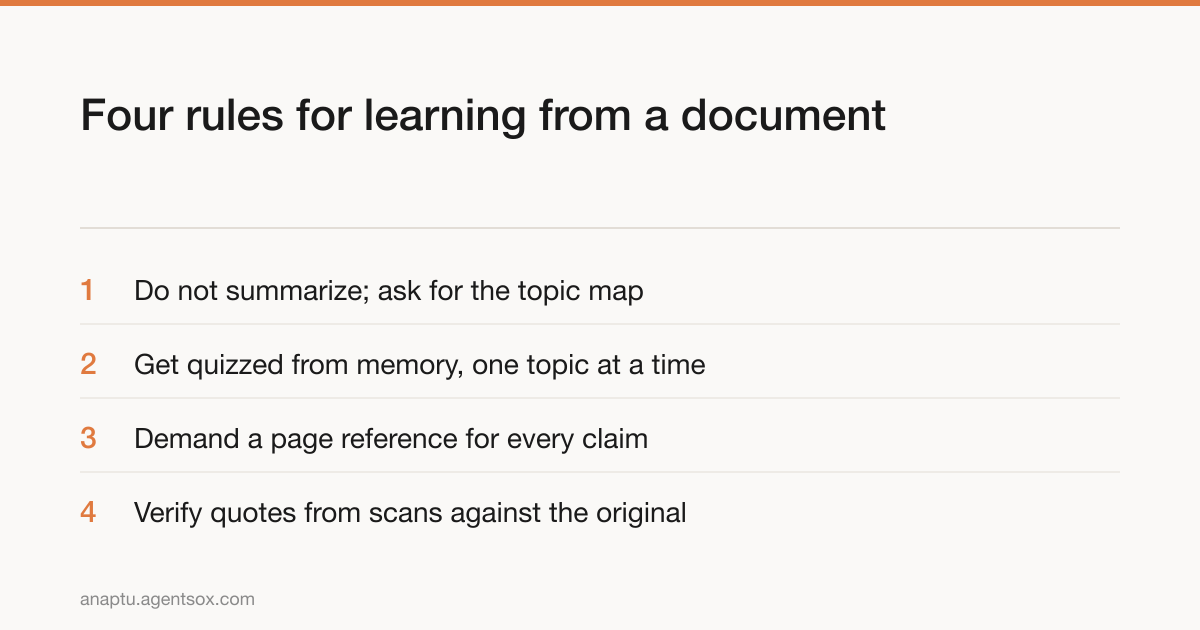
Three things happen here. You get a map of the document instead of a digest of it. You see the right reading order, which is usually not the page order. And the cognitive work stays with you.
After you answer, ask it to tell you where you were wrong, with a page reference.
Always demand references
Demand a page or a quote for every claim, because otherwise you cannot tell what is written in your document from what the model knows about the world.
This is the easiest point to miss with your own material. A model answering your question draws either on the document you uploaded or on what it knows in general, and the two answers sound identical.
In study material the difference is critical. In your product's technical spec or an internal procedure, general knowledge is simply wrong. So every claim should arrive with a checkable page or quote, and verifying two or three at the start of a session is enough to know whether to trust the rest.
About scanned documents
Scans are the one place that needs extra care. Digital text works well, and a PDF born from a document is digital text. A scan of a printed page is different: it requires character recognition, whose quality varies with font and scan quality. A small recognition error in a number or a term is exactly the kind of mistake that is hard to catch.
So before building on a quote from a scan, compare it to the original page.
From a single document to a path
A single document becomes a path when you extract its topics, identify what is missing around them, and fill in. One document is almost never everything you need: it assumes background you may not have, and it leaves things out.
So the complete workflow is: extract the topics from the document, spot the gaps around them, assemble a path, and then learn it with spaced review rather than in one reading. That is the difference between shortening a file and using an AI tutor that teaches instead of giving answers, and it is how you learn anything with AI from material you already trust.
In Anaptu an uploaded document becomes the source of a topic path rather than a summary. The path is editable before you start, the way a personalized learning plan AI builds one, or a personal AI course grown from the document. Teaching is interrupted by questions and flashcards on a spaced schedule. Quotes point back to the exact place in your material they came from. The Hebrew edition of this article is at the same address in Hebrew.
Sources
- Karpicke, J. D., & Roediger, H. L. (2008). The Critical Importance of Retrieval for Learning. Science, 319(5865), 966–968.
- Dunlosky, J., Rawson, K. A., Marsh, E. J., Nathan, M. J., & Willingham, D. T. (2013). Improving Students' Learning With Effective Learning Techniques. Psychological Science in the Public Interest, 14(1), 4–58.
Questions
- Why not just ask for a summary of the document?
- Because the summary moves the cognitive work to the machine. Understanding what a summary says is not the same act as retrieving the material from memory, and the second is what makes it stay. A summary is useful for refreshing material you already knew, not for learning it the first time.
- What is the right prompt when uploading a document?
- Do not summarize; give the list of topics the document teaches, in dependency order, with page numbers for each; then ask me about the first topic without giving me the answer.
- How do I know an answer came from my document and not the model?
- Demand a reference. Every claim should arrive with a page or a quote you can check. Without that there is no way to tell what is written in your material from what the model knows about the world, and in study material that difference is critical.
- Does this work for scanned documents?
- It depends on the scan. Digital text works well; a scan of a printed page needs character recognition, and recognition quality varies. Always check a quote from a scan against the original page before building on it.
Anaptu turns a one-sentence goal into a structured path, then teaches it and tracks what you have actually mastered. English and Hebrew.
Name your goalKeep reading
Career change with AI: a learning path you can finish
The problem in reskilling is not scarcity of material but excess. How to cut it down to a list you can finish in the time you actually have.
Choosing an AI tutor: five things to check first
Most tools that call themselves an AI teacher are answer engines with a nice interface. Five short tests that separate the two.
How to remember what you learn: spacing, retrieval, and a real schedule
Most of what you learn is gone in a week, and the loss is preventable with two mechanics. What the research says about review timing, and a schedule to copy.