Private tutor vs AI tutor: the measured gap is smaller than you think

The measured difference between a human private tutor and a computer tutoring system is smaller than most people assume: 0.79 versus 0.76 standard deviations in VanLehn's 2011 meta-analysis, which examined rule-based systems, not language models. The practical difference, and this is my assessment rather than a research finding, lies less in explanation quality and more in availability, price structure, and two things a good human tutor still does that software does not: noticing you are discouraged, and insisting.
A private tutor is the solution everyone knows, and it genuinely works. The practical question is how much of that advantage survives when you replace the tutor with software, and at what price. To learn anything with AI you first need an honest answer to that.
There are numbers on this, and they are less dramatic than either of the two common slogans, nothing replaces a human teacher on one side and AI makes teachers obsolete on the other.
What the research actually found
In 1984 Benjamin Bloom published what became known as the 2 sigma problem: students who received one-to-one tutoring combined with mastery learning performed about two standard deviations above a conventional classroom. In plain terms, the average tutored student outperformed about 98% of the students in the control class. Bloom himself framed this as a problem: the result was excellent and impossible to fund at national scale, and the challenge he posed was to find group methods that approach it.
That number has been quoted heavily since, often without the caveat. Later reviews found smaller effects under realistic conditions.
The most useful review for this comparison is Kent VanLehn's 2011 meta-analysis, which examined human one-on-one tutoring and computer tutoring systems together:
- Human one-on-one tutoring: an improvement of about 0.79 standard deviations over ordinary classroom instruction.
- Intelligent tutoring systems: an improvement of about 0.76 standard deviations.
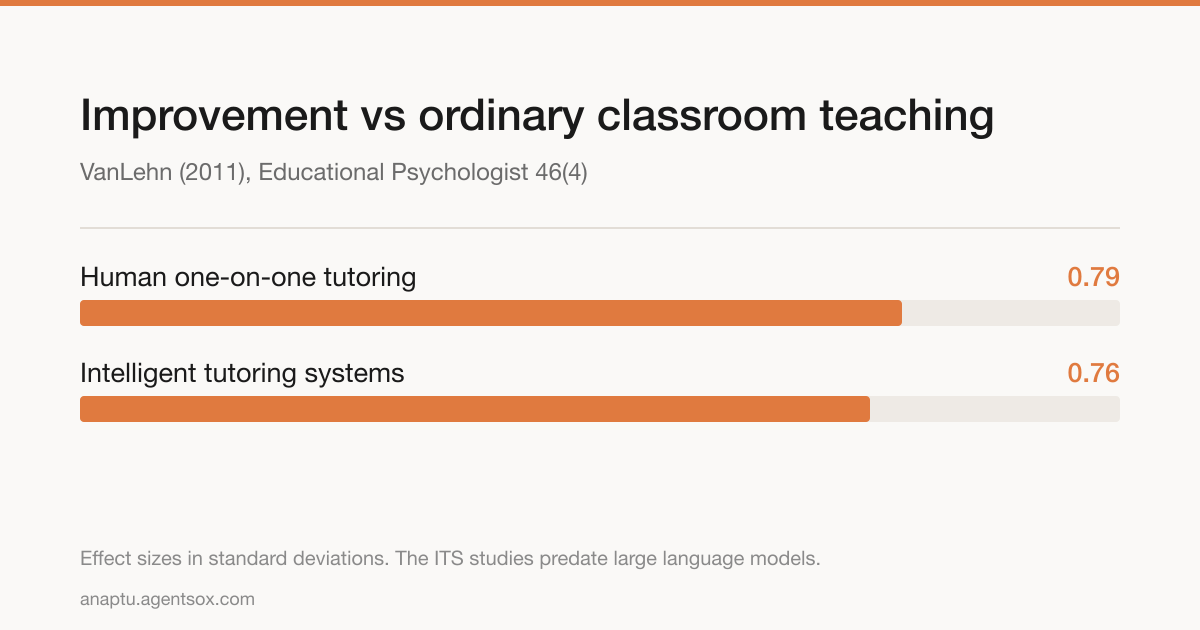
So the gap between a human tutor and a computer system is far smaller than the gap between either and studying alone with no guidance. That is a finding about averages across studies, not a promise about a particular student or subject, but it turns the question from can this work into under which conditions.
One caveat, and it may be the most important sentence in this article: VanLehn's review was published in 2011, and the systems it examined are rule-based systems from the decade before it. They are not language models, and they are not the tools you are comparing today.
The 0.76 is evidence that computer tutoring can work, not a measurement of any 2026 AI tool, ours or anyone else's. A measurement like that does not yet exist in the literature at comparable scale. Anyone citing that number as proof of a current AI tutor's quality, us included, is going beyond what the research shows.
Why the difference is so small
The difference is small because most of a private tutor's advantage is not in explanation quality but in three structural things, and all three can be automated.
The pace adapts. In a classroom the pace is set by the average, so some students waste time and others fall behind. One-on-one, whoever did not understand repeats, and whoever did moves on.
Gaps are caught early. A private tutor asks a question and discovers within a minute what is unclear. In a classroom the gap surfaces at the exam, weeks later.
Practice means retrieval, not listening. A tutor asks you to solve, explain, formulate. That is precisely the mechanism found most effective in learning research: retrieving material from memory preserves it far better than rereading it.
These three are mechanism, not charisma. That is where the line runs.
What software still does not do
Two things, and both are real: noticing a student is discouraged before they say so, and insisting that an unpleasant topic not be skipped.
Reading emotional state. A good tutor sees frustration before it is spoken and changes direction. Software detects a wrong answer, not despair.
Insisting. A human tutor does not let you skip a topic just because it is unpleasant, and a fixed appointment in the calendar creates commitment. Software ends the session the moment you close the window. If you know about yourself that you tend to quit when it gets hard, this is the central consideration, not explanation quality.
Where the price actually matters
The price matters through its structure more than its amount, and the structure changes behavior.
Hourly pricing turns every repetition into a financial decision. The method the research supports is spaced practice: short sessions repeated across weeks. Bought by the hour it is the most expensive shape there is, so in practice people skip it and concentrate everything into one long session before a test. Easy on the budget, bad for memory.
Subscription pricing makes the seventh repetition free. Not because repetition matters more than explanation, but because that way you can do it without doing arithmetic first.
The comparison at a glance
At a glance the comparison splits row by row: each row is won by a different tool, so the choice depends on which one matters to you.
| Human private tutor | AI tutor | |
|---|---|---|
| Measured effect | ~0.79 SD (VanLehn 2011) | ~0.76 SD, in pre-LLM systems |
| Availability | The tutor's calendar | Any hour, including 10pm |
| Pricing structure | Per hour, every repetition costs | Per month, the seventh repetition is free |
| Spaced practice | Expensive: many short sessions | Built into the schedule |
| Noticing discouragement | Yes, before you say it | No |
| Insistence and commitment | A fixed appointment | Ends when you close the window |
The bottom line
The bottom line is to choose by what you are missing, because on explanation quality the measured gap is smaller than commonly assumed. If you need someone who makes you show up, take a human tutor, and that is an entirely legitimate reason. If what you need is an ordered path with availability at any hour, where the seventh repetition costs nothing, an AI tutor for adults is the right tool. An AI that builds a curriculum from your goal is where it starts. The Hebrew edition of this article is at the same address in Hebrew.
Sources
- VanLehn, K. (2011). The Relative Effectiveness of Human Tutoring, Intelligent Tutoring Systems, and Other Tutoring Systems. Educational Psychologist, 46(4), 197–221.
- Bloom, B. S. (1984). The 2 Sigma Problem: The Search for Methods of Group Instruction as Effective as One-to-One Tutoring. Educational Researcher, 13(6), 4–16.
- Karpicke, J. D., & Roediger, H. L. (2008). The Critical Importance of Retrieval for Learning. Science, 319(5865), 966–968.
Questions
- Is an AI tutor really as effective as a human tutor?
- In Kent VanLehn's 2011 meta-analysis, one-on-one human tutoring improved achievement by about 0.79 standard deviations over ordinary classroom teaching, and computer tutoring systems improved it by about 0.76. The gap between the two is far smaller than the gap between either and unaided self-study. That is a finding about averages, not a promise about any one student.
- What does a human tutor do that an AI tutor does not?
- Two things. They notice you are getting discouraged before you say so, and they insist: they do not let you skip a topic because it is unpleasant. Software ends the conversation the moment you close the window.
- When is an AI tutor actually the better choice?
- When the constraint is availability rather than quality. If you study at 10pm, if your subject is too narrow to find a tutor for, or if you need the same explanation repeated seven times without apologizing, availability wins. Spaced repetition needs short frequent sessions, which is exactly what is expensive to buy by the tutoring hour.
- How does the cost compare to a private tutor?
- The structure differs, not just the amount. A private tutor is priced by the hour, so every repetition costs money and creates pressure to skip it. A subscription is priced by the month, so the seventh repetition costs the same as the first. When the method that works needs many short repetitions, the pricing structure is not a technical detail.
Anaptu turns a one-sentence goal into a structured path, then teaches it and tracks what you have actually mastered. English and Hebrew.
Name your goalKeep reading
Career change with AI: a learning path you can finish
The problem in reskilling is not scarcity of material but excess. How to cut it down to a list you can finish in the time you actually have.
Choosing an AI tutor: five things to check first
Most tools that call themselves an AI teacher are answer engines with a nice interface. Five short tests that separate the two.
How to remember what you learn: spacing, retrieval, and a real schedule
Most of what you learn is gone in a week, and the loss is preventable with two mechanics. What the research says about review timing, and a schedule to copy.