Learning with ChatGPT: what works, what fails, and how to close the gap

ChatGPT explains better than most books, and people still finish a month of conversations with it remembering very little. The reason is not answer quality but three structural traits: it reacts instead of planning, it explains instead of testing, and it keeps no record of what you retained. The first two have a workaround in how you phrase the request. The third does not.
This is not another list of reasons a general chatbot is bad. ChatGPT explains topics better than most books I have read, with infinite patience, at any hour. Anyone who says otherwise has not tried seriously.
And yet people finish a month of conversations with it about a subject and find that little stayed, and the difference is measured: people who were tested on material recalled about 80% of it a week later, versus 36% and 33% for those who only reread it. The reason is not the quality of ChatGPT's answers. It is three structural traits of a chat, and two of them have a workaround that makes it possible to really learn anything with AI.
Gap 1: it reacts, it does not initiate
A chat reacts rather than initiates, so you decide every next question at the exact moment you know the least about the subject.
A chat answers the question in front of it. That means someone has to decide what the next question is, and that someone is you, at the moment you know less about the subject than anyone else involved.
The result is familiar: you learn what you knew to ask about, and never find out what you missed. That is not a failure of the model. It is a failure of the format.
The workaround, and it works: ask for a plan before any explanation.
I want to get to X. Do not explain anything yet. Give me a dependency-ordered
list of topics leading from where I am now to X, mark what can be skipped, and
stop after the list.
If you remember only one prompt from this article, make it that one. It turns a tool that reacts into a tool that plans. Once you have the list, delete half of it: cutting is the step that decides whether a course finishes.
Gap 2: it explains, it does not test
A chat explains rather than tests, and a good explanation produces the feeling of understanding without the memory that should come with it.
That feeling is exactly what misleads. The most stable finding in learning research is that retrieving something from memory preserves it far better than reading it again.
In Karpicke and Roediger's 2008 study, people who kept being tested on word pairs recalled about 80% of them a week later. People who kept rereading without being tested recalled 36% and 33%. The group that remembered less felt more confident.
| What they did with the material | Recalled a week later |
|---|---|
| Kept being tested on it (retrieval) | about 80% |
| Kept rereading it | 36% and 33% |
In the authors' own words:
Repeated studying after learning had no effect on delayed recall, but repeated testing produced a large positive effect.
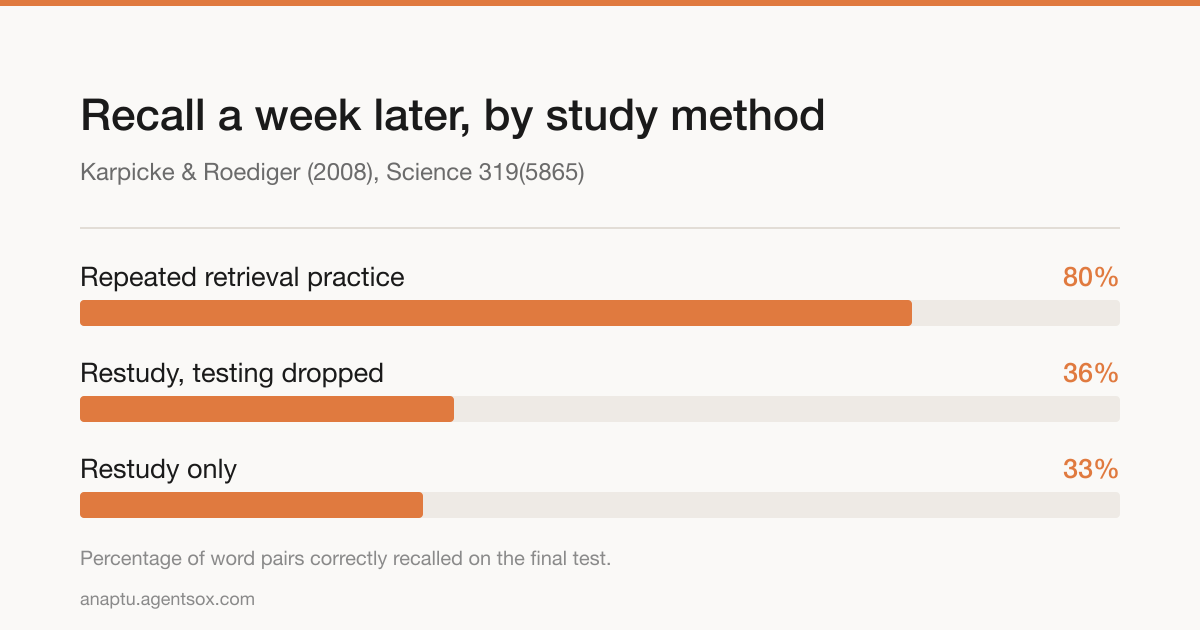
Reading a brilliant ChatGPT answer is precisely the second condition.
The workaround: ask to be tested instead of understood.
Ask me three questions about what you just explained. Do not give me the
answers. After I reply, tell me where I was wrong and why.
And at the end of every session, formulate what you learned today from memory, without scrolling up. If you cannot, you did not learn it, even if you understood it.
Gap 3: it keeps no record, and there is no workaround
A chat keeps no record of what you forgot, and no workaround in phrasing exists for this gap, unlike the previous two.
Here it stops. You can ask a chat to quiz you today. You cannot make it know that you failed a topic ten days ago and bring that topic back exactly when you are about to forget it.
This matters because review timing has structure. In Cepeda and colleagues' work, the optimal gap between reviews depends on how far ahead you need to remember: the longer the horizon, the wider the spacing should grow. Effective review is a schedule, not a mood.
A chat history is not a model of what you know. It is a transcript of what was said. You can keep manual records in a file, and in practice almost nobody keeps it up for more than two weeks.
When you actually need something else
You need something else only when the goal spans weeks. For a single question ChatGPT is the right tool: fast, cheap, and good at it. If what you are learning ends in one evening, do not complicate it.
The gap opens when the goal crosses weeks. A teacher does three jobs for you. They plan the order. They test you. They remember what you forgot. Past one evening of material, all three land on you, on top of the learning itself.
Anaptu is built around exactly those three: a goal goes in, an editable topic path comes out, teaching is interrupted by questions and flashcards on a spaced schedule, and the system records which topics you have proven. It is an AI tutor that teaches instead of giving answers.
But if you apply only the two prompts above in the chat you already have, you will gain more than most people who read this article. The Hebrew edition is at the same address in Hebrew.
Sources
- Karpicke, J. D., & Roediger, H. L. (2008). The Critical Importance of Retrieval for Learning. Science, 319(5865), 966–968.
- Cepeda, N. J., Vul, E., Rohrer, D., Wixted, J. T., & Pashler, H. (2008). Spacing Effects in Learning: A Temporal Ridgeline of Optimal Retention. Psychological Science, 19(11), 1095–1102.
Questions
- Can I learn a whole subject with ChatGPT?
- You can, but you have to do the three jobs a teacher does yourself: plan the order, force yourself to be tested, and track what you have forgotten. The tool will not remind you to do any of them.
- What is the single best prompt for learning with ChatGPT?
- Ask for a plan before any explanation. Tell it where you want to get to, ask for a dependency-ordered topic list that leads there, ask it to mark what can be skipped, and to stop after the list. That one request turns a tool that reacts into a tool that plans.
- Why do I forget what ChatGPT explains to me?
- Because reading a good explanation produces fluency, not memory. In Karpicke and Roediger's study, people who kept being tested recalled about 80% of the material a week later; people who kept rereading it recalled 36% and 33%, and felt more confident while remembering less.
- What can ChatGPT not do for learning, no matter the prompt?
- Keep a record. It can quiz you today, but it cannot know that you failed a topic ten days ago and bring it back exactly when you are about to forget it. A chat history is a transcript of what was said, not a model of what you know.
Anaptu turns a one-sentence goal into a structured path, then teaches it and tracks what you have actually mastered. English and Hebrew.
Name your goalKeep reading
Career change with AI: a learning path you can finish
The problem in reskilling is not scarcity of material but excess. How to cut it down to a list you can finish in the time you actually have.
Choosing an AI tutor: five things to check first
Most tools that call themselves an AI teacher are answer engines with a nice interface. Five short tests that separate the two.
How to remember what you learn: spacing, retrieval, and a real schedule
Most of what you learn is gone in a week, and the loss is preventable with two mechanics. What the research says about review timing, and a schedule to copy.